
Subsistence minimum in Nizhny Novgorod region in 2026: per person, child and pensioner
The subsistence minimum in Nizhny Novgorod region for 2026 is 17,803 rubles per month per capita. For working‑age persons it is 19,405 rubles, for pensioners 15,311 rubles, for children 17,269 rubles. Each of the four amounts equals 94 % of the nationwide level, the per‑person difference is 1,136 rubles. Based on these figures the region assigns a universal child benefit and a pension supplement, calculates fixed alimony and the part of income that cannot be seized for debt. Below is a calculation for different families, the minimum by year since 2013, a comparison with neighboring regions and with what residents of Nizhny Novgorod actually earn. Rosstat figures; each chart can be opened on the website in interactive form.
Subsistence minimum in Nizhny Novgorod region in 2026: table
| Group | Nizhny Novgorod region | Russia | 2025, region |
|---|---|---|---|
| Per capita | 17,803 | 18,939 | 16,669 |
| Working‑age | 19,405 | 20,644 | 18,169 |
| Pensioners | 15,311 | 16,288 | 14,335 |
| Children | 17,269 | 18,371 | 16,169 |
Rubles per month. Source: Rosstat.
For employed people the regional minimum is lower than the Russian one by 1,239 rubles, for pensioners by 977 rubles, for children by 1,102 rubles. The share of 94 % has been held in all groups since 2022 and does not change. Earlier the groups diverged: in 2021 the child minimum in the region was 97.6 % of the Russian level, while the working‑age minimum was only 90.9 %.
The pensioner minimum in the region is 78.9 % of the working‑age minimum, the child minimum 89.0 %. The same 17,803 rubles per capita are set, for example, in Ivanovo, Samara and Rostov regions.
Open subsistence minimum for all regions and groups since 2013 →
How much a family needs at minimum
The minimum is calculated per person. For a family, the amounts are summed according to its composition.
Two working parents and two children. 2 × 19,405 + 2 × 17,269 = 73,348 rubles per month. According to Russian standards, the same family reaches 78,030 rubles, 4,682 rubles more.
Mother with a child. 19,405 + 17,269 = 36,674 rubles.
A couple of non‑working pensioners. 2 × 15,311 = 30,622 rubles.
Unified child benefit
A family receives the unified benefit if its per‑capita income is below the minimum per capita in its region. In Nizhny Novgorod Oblast this is 17,803 rubles per person. For a family of four, the threshold is 71,212 rubles of total income per month, for a family of three it is 53,409 rubles. In addition to income, the Social Fund checks assets, deposits and the employment of adults. How many families in the country live below this line is examined in the article about low‑income families.
Fixed‑amount alimony
When the payer's earnings are irregular or hard to verify, a court may set alimony as a fixed amount. It is linked to the child minimum in the region where the child lives. In Nizhny Novgorod Oblast half of the child minimum equals 8,634.5 rubles, the full minimum is 17,269 rubles. After the minimum is revised, alimony is indexed accordingly. How the average salary enters the alimony calculation is explained in the article average salary for alimony.
How much must be left to the debtor
When collecting debts, a person must retain an amount not less than the working‑age minimum in his region. A resident of Nizhny Novgorod in 2026 is entitled to keep 19,405 rubles per month. If there are dependent children, one can ask to leave their minima as well, 17,269 rubles for each.
Subsistence minimum in Nizhny Novgorod Oblast by year
In 2013 the per‑capita minimum in the oblast was 6,577 rubles, and for 2026 it is 17,803 rubles, i.e. it increased 2.7 times. The Russian figure grew 2.59 times over the same period, from 7,306 to 18,939 rubles. In percentage terms the oblast was catching up with the country, while the gap in rubles widened: 729 rubles in 2013 and 1,136 now.
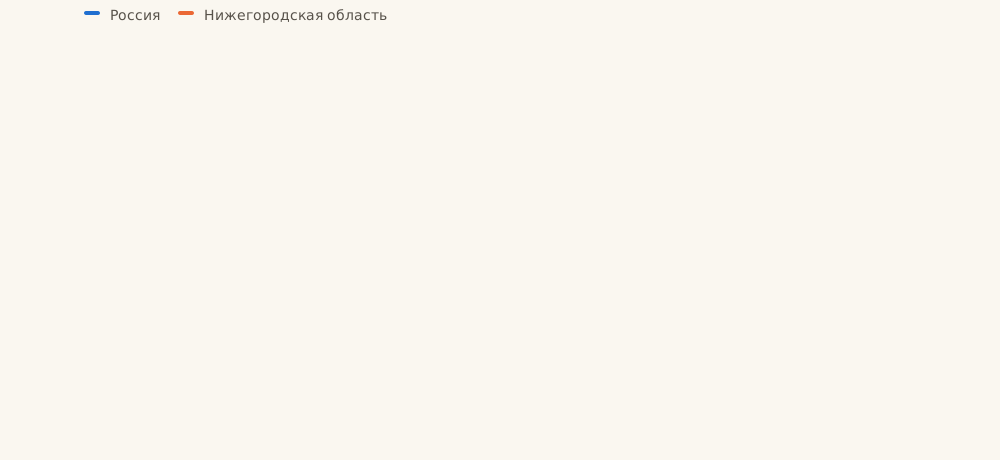
The most noticeable drop on the chart occurs in 2016. The minimum in the oblast even fell then, from 8,822 to 8,755 rubles, while the Russian figure rose to 9,828. The Nizhny Novgorod amount fell to 89.1% of the national level, lower than in any other year of the series. Since 2019 the lag has been shrinking, and from 2022 the share has settled at 94%.
In 2022 the minimum was revised twice. From 1 January the per‑capita amount in the oblast was 11,895 rubles, and from 1 June after a 10% indexation it was already 13,085. Until 2021 the amount was set quarterly; now it is approved for the whole year at once.
For 2026 all four figures increased by 6.8%: per capita by 1,134 rubles, for workers by 1,236, for pensioners by 976, for children by 1,100. You can compare the 2013 minimum with the current one in the same money in the inflation calculator.
Open the per‑capita minimum in Nizhny Novgorod Oblast by year →
Nizhny Novgorod Region Among Neighbours
Rosstat publishes the minimum for 2026 for 89 territories. It is higher than Nizhny Novgorod's in 50 of them, lower in 30, and the same in eight.

Eight regions border Nizhny Novgorod Region. The minimum is higher only in Vladimir Region, 18,371 rubles. In Ivanovo it is the same, 17,803. In Kostroma Region 17,424 rubles, in Kirov and Ryazan each 16,856, in Mari El 16,666, in Chuvashia 16,477, in Mordovia 16,098. For comparison, in Moscow the minimum per capita is 25,342 rubles, 7,539 more than Nizhny Novgorod's.
All regions are listed in descending order in the regional ranking by living minimum, the overall picture for the country is described in the article living minimum 2026 by regions.
Minimum and real incomes of Nizhny Novgorod residents
The average accrued salary in Nizhny Novgorod Oblast in 2025 was 81,408 rubles, which is 4.5 times the working‑age minimum for the same year (18,169). Across Russia the average salary was 101,784 rubles and exceeds the Russian minimum by 5.3 times. According to monthly data for July 2026 the average salary in the region was 90.4 thousand rubles, in the country 109.5 thousand.
Open salaries by region by month 2026 →
Half of the region’s workers in 2025 earned more than 67,691 rubles, the median for Russia was 73,871 rubles. In the region the median equals 81.1% of the average salary, in the country 74.3%. Nizhny Novgorod salaries are lower than the Russian average, but they are distributed more evenly.
Open median salary by region →
Rosstat also calculates the direct ratio: how many times the per‑capita monetary income exceeds the subsistence minimum. Here Nizhny Novgorod Oblast outperforms the country. In 2025 the income per person in the region was 72,320 rubles per month, in Russia 74,932, i.e., lower. But the minimum is also 6% lower, so in “minimums” a Nizhny Novgorod resident is better off: 433.9% versus 422.6% on average nationwide.
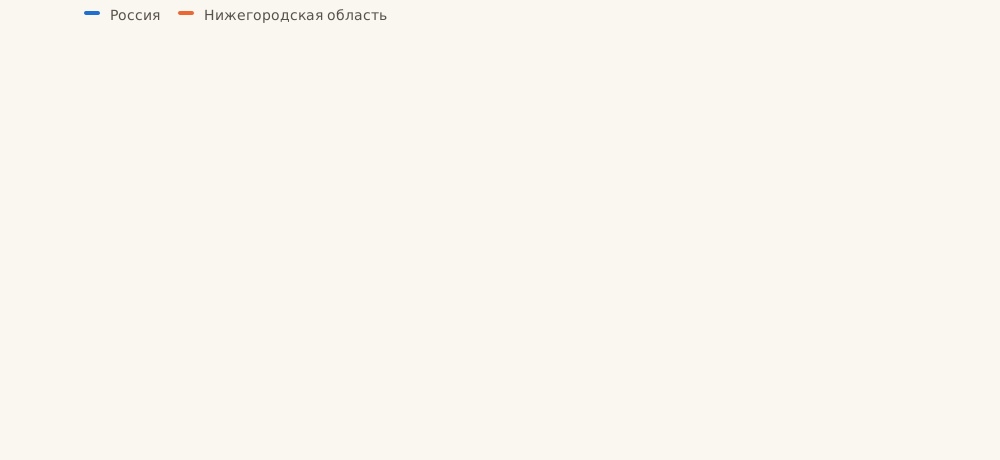
In 2013 the incomes of Nizhny Novgorod residents exceeded the minimum by 3.71 times, and across the country by 3.51 times. The worst year was 2020, 327.1%. In 2023 the region almost matched the country (374.5% versus 372.7%), then pulled ahead again. Quarterly data for the second quarter of 2026: 429.3% in the region and 405.1% in Russia. For the first half of 2026 the per‑capita income in the region was 72,077 rubles per month, in the country 72,500, a difference of only 423 rubles.
Open income‑to‑minimum ratio by quarter →
How many people live below the minimum
In 2025 incomes below the poverty line were recorded for 5.2% of Nizhny Novgorod Oblast residents, versus 6.7% in Russia. For the region this is the lowest share since 1995, when the series begins. In 2000, 35.4% of Nizhny Novgorod residents fell below the line, more than a third, and the region was noticeably poorer than the country’s 29.0%.
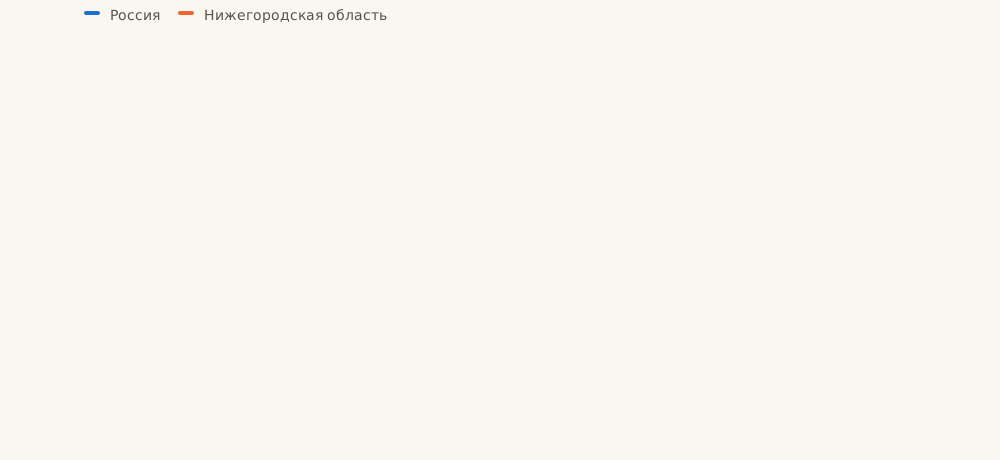
Since 2010 the share of the poor in the region has been lower each year than the Russian average. Workers earning less than the subsistence minimum in 2025 amounted to 2.1%, versus 2.3% nationwide. In 2011 such workers made up 14.9% of the region, almost one in seven.
Open share of population below the poverty line in Nizhny Novgorod Oblast →
Minimum pensioner and pension supplement
If an unemployed pensioner receives a pension together with other payments that is lower than the pension minimum in his region, the state pays the difference. In Nizhny Novgorod Oblast for 2026 this threshold is 15,311 rubles, a year ago it was 14,335, an increase of 976 rubles. In 2013 the threshold was 5,731 rubles. In 2022 it was revised twice: from January 10,230 rubles, from June 11,253.
How the social supplement works and how many people receive it is explained in the article about pensioner subsistence minimum. Regional row: pensioner minimum in Nizhny Novgorod Oblast by year.
Questions and answers
What is the subsistence minimum in Nizhny Novgorod Oblast in 2026?
Per capita 17,803 rubles per month. For able‑bodied 19,405, for pensioners 15,311, for children 17,269.
What is the subsistence minimum per child in Nizhny Novgorod Oblast in 2026?
17,269 rubles per month. In 2025 it was 16,169.
Why is the minimum in Nizhny Novgorod Oblast lower than the Russian average?
Since 2021 the minimum is calculated from the median income, not from the cost of a food basket, and regions set their own amounts. The median income in the oblast is lower than the Russian one: in 2025 it was 53,588.6 rubles versus 55,027.8. Since 2022 the Nizhny Novgorod minimum in all groups equals 94% of the nationwide figure.
Is there a separate subsistence minimum for the city of Nizhny Novgorod?
No. One amount applies to the whole oblast: in Nizhny Novgorod, Dzerzhinsk, Arzamas and the villages the same minimum is used.
In short
- Subsistence minimum in Nizhny Novgorod Oblast for 2026: 17,803 rubles per capita, 19,405 for able‑bodied, 15,311 for pensioners, 17,269 for children.
- This is 94% of the nationwide amounts. Among eight neighboring regions only Vladimir Oblast is higher.
- A family with two working adults and two children needs 73,348 rubles per month according to the minimum; the threshold for a unified benefit for such a family is 71,212 rubles of income.
- Over the year all figures rose by 6.8%, 2.7 times since 2013.
- Residents' incomes in 2025 were 4.34 times higher than the minimum, more than the national average. 5.2% of the population is below the poverty line.