
Minimum subsistence level for pensioners in 2026: figures for Russia and its regions
The minimum subsistence level for pensioners in 2026 for Russia is 16,288 rubles per month. A year ago it was 15,250, an increase of 6.8%. For a pensioner this is the main figure of the year: if the pension together with other payments is lower than the minimum of his region, the state pays the difference. In Moscow the level is 18,971 rubles, in St. Petersburg 17,754, in the Moscow region 17,446. The lowest is in Lipetsk and Tambov oblasts, at 13,518 rubles, the highest in Chukotka, 42,511. These are Rosstat data, further details can be opened on interactive charts.
How the pensioner's minimum turns into an allowance
The minimum itself is not paid out to anyone. It is compared with what the pensioner receives per month: pension plus other regular cash payments, for example a monthly cash benefit for beneficiaries. If the amount does not reach the regional minimum, an unemployed pensioner is granted a social allowance, and the income becomes exactly equal to the minimum.
Who pays depends on the region. Where the local minimum is not higher than the nationwide one, the Social Fund pays the allowance, it is called federal. Where it is higher, the regional budget pays, and the allowance is regional.
Example: pensioner with a social pension
A social pension is received by those who have not accrued an insurance period. As of 1 January 2026 there are 3,525 thousand such pensioners, and the average size of a social pension is 15,479.7 rubles. This is lower than the minimum almost everywhere in the country.
Let’s see what this means for a person with an average social pension and no other payments:
- In Moscow the pensioner minimum is 18,971 rubles. The allowance will be about 3,491 rubles per month.
- In Tula or Yaroslavl oblast the minimum is exactly the nationwide one, 16,288. The allowance is about 808 rubles.
- In Tambov oblast the minimum is 13,518 rubles, the average social pension is higher than it. There will be no allowance.
The same pension in one region requires an allowance of three and a half thousand rubles, while in another none. Therefore, you need to look at the minimum for your own subject: the regional ranking of pensioner minimum subsistence levels shows them all.
Minimum pensioner and average pension
The average pension on 1 January 2026 was 25,254 rubles, 1.55 times higher than the pensioner minimum. In July 2026 it was 25,402 rubles. Adjusted for price growth, pensions for January–July were 2.6% higher than a year earlier.
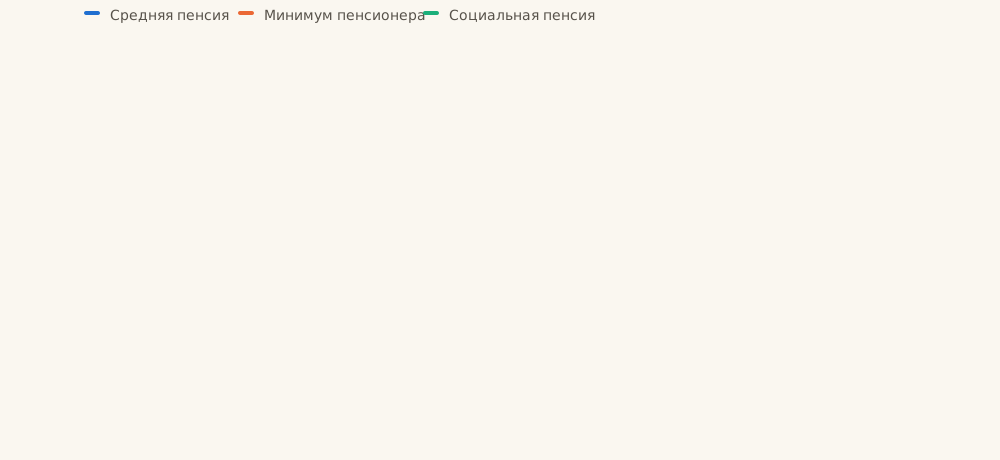
The chart shows that the gap between the average pension and the minimum changes little. In 2017 the average pension was 145.5% of the minimum, in 2020 it was 160.1%, and in 2026 it was 155.0%. The social pension, on the contrary, stays close to the minimum. In 2017–2019 it was slightly above it (in 2017, 8,644 rubles versus 8,540), and since 2020 it has been slightly below. The difference is covered by an additional payment.
Open the number of pensioners and average pensions by type → All years of average pension are compiled in the summary "Average pension by year".
Minimum subsistence level for pensioners by region in 2026
The gap between the extreme regions is more than threefold: 42,511 roubles in Chukotka and 13,518 in the Lipetsk and Tambov regions.

The top of the list is occupied by the North and the Far East. After Chukotka come Kamchatka Krai (28,666), Magadan Oblast (28,340), Nenets Autonomous Okrug (26,712) and Yakutia (24,594). Food, clothing and heating are more expensive there, and the minimum takes this into account.
At the bottom are the Black Earth region and the Volga region. Apart from the Lipetsk and Tambov regions, this includes Belgorod, Penza and Saratov, each at 13,682 roubles.
Above the national average, the minimum is higher in both capitals, in the Moscow region and in Leningrad Oblast, almost throughout the North, in Siberia and in the Far East. There are also unexpected entries: in Kabardino-Balkaria the pensioner minimum is 17,428 roubles, the same as in Leningrad Oblast. In most regions of the European part and the Volga region it is below 16,288, meaning the Social Fund pays the supplement there.
The minimum for a region for all years is available on a separate page, for example in Moscow, in Saint Petersburg or in Tambov Oblast. Open the table of the pensioner minimum for all regions since 2013 →
Where the minimum grew the least
The nationwide figure and most regions increased by the same 6.8% for 2026. The smallest rises were in Moscow (6.0%), in Tambov Oblast and Nenets Okrug (each 5.7%), in Moscow Oblast (5.1%), in Murmansk Oblast and Yugra (each 4.0%).
Minimum subsistence level for retirees by year
In 2013 the minimum for a retiree in Russia was 6,131 rubles, in 2026 it was 16,288, 2.7 times more. In the regions the picture is similar, but the starting points differed greatly: in Tambov Oblast in 2013 it was 4,102 rubles, in Moscow 7,137.
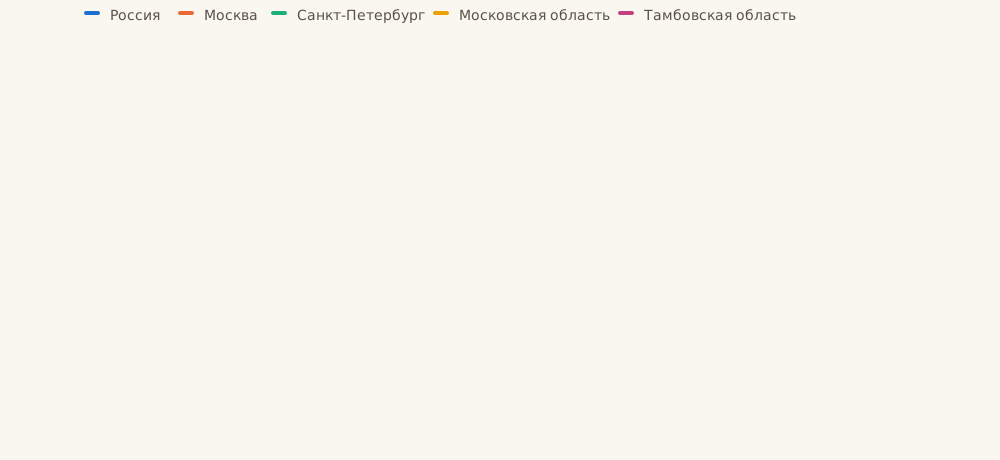
Two points on the chart are noticeable immediately. First: in 2016–2020 the lines are almost flat. The Russian minimum in 2016 was 8,803 rubles, in 2017 it was 8,540, that is it even fell, and it only reached 9,311 by 2020. Second: the jump of 2022. From January 1 the retiree minimum was 10,882 rubles, and from June 1 it was raised by 10%, to 11,970. This is the only time in all years that the amount was changed mid‑year.
How to recalculate the old minimum into today's money is suggested by the inflation calculator, and how much prices have risen this year can be seen on the page inflation for 2026.
How many retirees receive an allowance
According to the Social Fund data published by Rosstat, the social allowance to pensions in 2025 was received by 6,497,092 people. The total number of retirees on January 1, 2026 was 40,523 thousand. The share of allowance recipients in 2024 was 14.9%, about one in seven retirees.
The composition has changed. In 2017 federal allowance was received by 4,173,219 people, regional by 2,499,196. In 2025 federal by 3,219,928, regional by 3,277,164. Now the regional allowance, paid by the local budget, is received by slightly more people than the federal one.
Open the number of social allowance recipients →
Questions and Answers
What is the subsistence minimum for retirees in 2026?
Across Russia it is 16,288 rubles per month. For the supplement they take the minimum of the respective region: in Moscow 18,971, in Saint Petersburg 17,754, in the Moscow region 17,446.
Who sets the retirees' minimum?
Since 2021 it is set once a year for the following year. The nationwide figure for 2026 is defined by Federal Law No. 426-FZ of 28 November 2025, and for 2025 it was set by Government Decree No. 789 of 12 June 2024. Regional amounts are adopted by the authorities of the subjects, Rosstat compiles them into a single table.
Is a supplement granted to a working retiree?
No, the social supplement up to the subsistence minimum is granted only to non‑working retirees.
Why is the retirees' minimum lower than that for the able‑aged?
That is how the calculation works: it is assumed that a person who goes to work needs more per month. In 2026 the able‑aged minimum for Russia is 20,644 rubles, the per‑capita minimum is 18,939, and for retirees it is 16,288.
Where is the highest retirees' minimum?
In Chukotka, 42,511 rubles. Followed by Kamchatka Krai (28,666) and Magadan Oblast (28,340).
In Brief
- The subsistence minimum for retirees in 2026 across Russia is 16,288 rubles, 6.8% higher than in 2025.
- In Moscow 18,971 rubles, in Saint Petersburg 17,754, in the Moscow region 17,446. The maximum is in Chukotka (42,511), the minimum in Lipetsk and Tambov Oblasts (13,518).
- If a pension together with other payments is below the regional minimum, the non‑working retiree receives a supplement for the difference. About 6.5 million people receive the supplement.
- The average pension as of 1 January 2026 is 25,254 rubles, 1.55 times the minimum. The average social pension is 15,479.7 rubles, slightly below it.