
Life expectancy by Russian region: ranking of subjects and charts
People in Russia live the longest in Dagestan: life expectancy at birth there is 79.87 years. Next are Moscow (79.38) and Ingushetia (79.2). It is lowest in Chukotka and Tuva, 66.56 and 66.59 years. The difference between the first and last place is 13.3 years, and the national average is 73.41 years. These are Rosstat data for 2023, the latest published by region. Below is a full breakdown: who is at the beginning and end of the list, what the federal districts look like, which regions have not returned to pre-COVID levels, and how many years people will live without serious illnesses. Each chart has an interactive version on the website.
What is life expectancy
This is not the average age of the deceased. Rosstat takes mortality at each age for a specific year and calculates how long a newborn would live on average if these conditions remained throughout their life. Therefore, the indicator reacts quickly to everything that changes mortality: in 2021, it fell across the country, and in 2022, it recovered.
An important consequence: the age composition of a region does not directly affect the figure. The young population of the Caucasus does not in itself raise it in the ranking; the calculation is based on mortality within each age group.
Ranking of regions by life expectancy in 2023
There are 83 constituent entities in the Rosstat table. Autonomous okrugs of Arkhangelsk and Tyumen oblasts are listed as separate rows; data for the DPR, LPR, Zaporozhye and Kherson oblasts are not yet included.
| Rank | Region | Years |
|---|---|---|
| 1 | Republic of Dagestan | 79.87 |
| 2 | Moscow | 79.38 |
| 3 | Republic of Ingushetia | 79.20 |
| 4 | Kabardino-Balkarian Republic | 77.14 |
| 5 | Saint Petersburg | 76.55 |
| 6 | Khanty-Mansi Autonomous Okrug (Yugra) | 76.32 |
| 7 | Chechen Republic | 76.26 |
| 8 | Karachay-Cherkess Republic | 76.25 |
| 9 | North Ossetia (Alania) | 76.16 |
| 10 | Sevastopol | 76.11 |
| ... | ... | ... |
| 74 | Kurgan Oblast | 69.79 |
| 75 | Republic of Karelia | 69.75 |
| 76 | Republic of Buryatia | 69.54 |
| 77 | Altai Republic | 69.39 |
| 78 | Magadan Oblast | 69.30 |
| 79 | Jewish Autonomous Oblast | 68.30 |
| 80 | Amur Oblast | 68.25 |
| 81 | Zabaykalsky Krai | 67.17 |
| 82 | Republic of Tyva | 66.59 |
| 83 | Chukotka Autonomous Okrug | 66.56 |
Only 24 regions have life expectancy above the Russian average of 73.41 years, while the remaining 59 are below. 13 constituent entities have crossed the 75-year mark, and 11 have an indicator of less than 70 years.
There are three types of regions at the top of the list. The first: republics of the North Caucasus; there are six of them in the top ten. The second: the two capitals and Sevastopol. The third: oil and gas okrugs, Yugra (76.32) and Yamal (75.3). The bottom is almost entirely Siberia and the Far East.
The full list with a map is available on the ranking of regions by life expectancy page, and for each constituent entity, you can open a separate chart, for example Dagestan or Chukotka.
How the gap between regions has changed
In 2010, the difference between the leader and the laggard was more than 17 years: Ingushetia 74.71 years, Chukotka 57.49. Over thirteen years, Chukotka added 9.07 years, more than any other subject, and Tuva 6.14 years. Growth among the leaders was slower: Ingushetia added 4.49 years. As a result, the gap narrowed to 13.3 years.
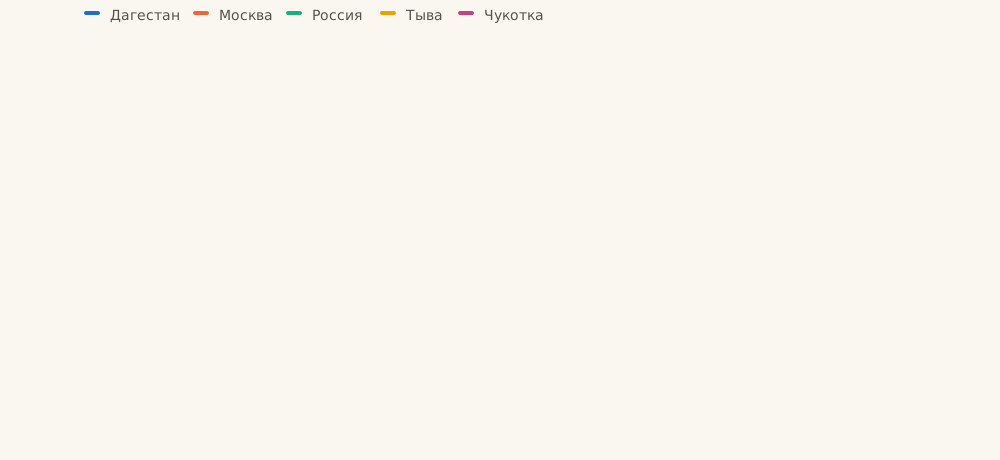
Something else is also visible. In 2010, Moscow lagged behind Ingushetia by 0.56 years, but in 2023 it overtook it: 79.38 versus 79.2. Among large regions, Leningrad Oblast (+6.79 years since 2010) and Yakutia (+6.8) grew the fastest. Murmansk (+2.01) and Kurgan (+2.13) oblasts grew the slowest: in 2010, Murmansk lagged behind the Russian average by half a year (68.43 versus 68.94), and now it lags by almost three (70.44 versus 73.41).
All 96 rows of the table, along with the districts, are available in the chart of life expectancy by region for 2010-2023.
Life expectancy by federal district
| Federal district | 2010 | 2019 | 2021 | 2023 |
|---|---|---|---|---|
| North Caucasian | 72.19 | 76.42 | 73.60 | 77.00 |
| Central | 69.93 | 74.61 | 71.08 | 74.79 |
| Northwestern | 68.90 | 73.61 | 70.40 | 73.83 |
| Southern | 70.12 | 73.77 | 70.32 | 73.60 |
| Ural | 68.82 | 72.54 | 69.66 | 72.88 |
| Volga | 68.38 | 72.94 | 69.56 | 72.75 |
| Siberian | 67.10 | 71.06 | 68.25 | 71.05 |
| Far Eastern | 65.76 | 70.08 | 67.95 | 69.81 |
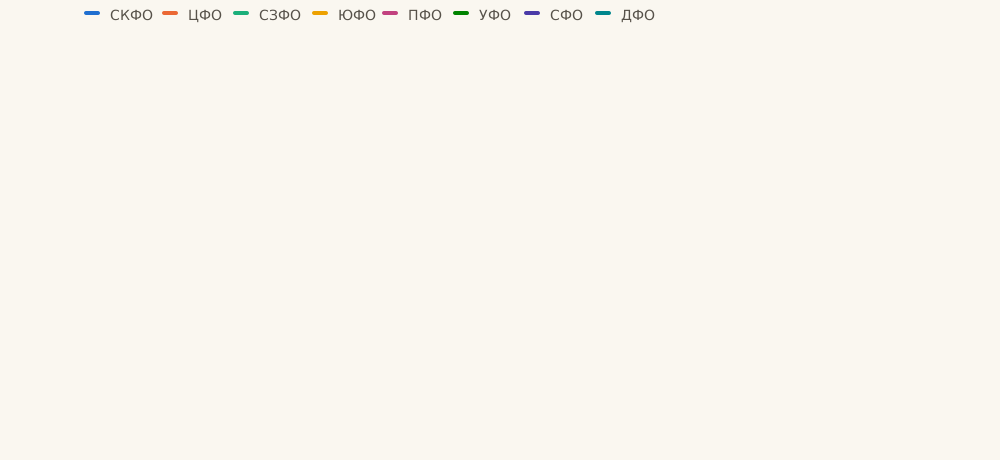
There is a 7.19-year difference between the North Caucasus and the Far East. The Far Eastern District is the only one where the indicator in 2023 still did not reach 70 years. Four districts remained below the 2019 level: Far Eastern, Volga, Southern, and Siberian (the latter has a difference of only 0.01 years).
Have the regions returned to the 2019 level
For Russia as a whole, yes, and even then with a minimal margin: 73.41 years in 2023 against 73.34 in 2019. In 2021, the indicator dropped to 70.15. Moscow saw the sharpest decline, from 78.08 to 74.6, but it also recovered faster than the others and added 1.3 years to its pre-COVID level.
By region, the picture is worse. Only 30 subjects out of 83 surpassed the 2019 level. The biggest losses were in:
- Nenets Autonomous Okrug: 72.55 years in 2019, 70.67 in 2023 (−1.88);
- Zabaykalsky Krai: 68.49 and 67.17 (−1.32);
- Republic of Buryatia: 70.71 and 69.54 (−1.17);
- Kurgan Oblast: 70.75 and 69.79 (−0.96);
- Lipetsk Oblast: 73.38 and 72.44 (−0.94).
Small regions like the Nenets Autonomous Okrug should be read with caution: tens of thousands of people live there, and a few extra deaths in a year noticeably shift the figure.
Healthy life: how many years without illness
Rosstat has a second indicator, healthy life expectancy. It shows how many years a person will live on average without health-related limitations. For Russia in 2023, this is 61.4 years, meaning the last 12 years of life on average are spent with illnesses.
Here the ranking is different. The top places:
| Region | Healthy life, years | Total life, years |
|---|---|---|
| Republic of Tatarstan | 68.3 | 75.23 |
| Chechen Republic | 68.1 | 76.26 |
| Moscow | 65.4 | 79.38 |
| Saint Petersburg | 64.7 | 76.55 |
| Republic of Dagestan | 64.7 | 79.87 |
And the last ones:
| Region | Healthy life, years | Total life, years |
|---|---|---|
| Chukotka Autonomous Okrug | 40.4 | 66.56 |
| Jewish Autonomous Oblast | 46.3 | 68.30 |
| Republic of Kalmykia | 48.8 | 74.53 |
| Nenets Autonomous Okrug | 49.0 | 70.67 |
| Altai Republic | 52.4 | 69.39 |
Tatarstan is only 13th in total life expectancy, but first in healthy life: the difference between the two indicators there is 6.9 years. In Dagestan it is 15.2 years, in Moscow 14. Kalmykia is in the top twenty for total life expectancy (74.53), but almost at the very end for healthy life: 25.7 years of life with health-related limitations. In 2019, healthy life there was 60.4 years.
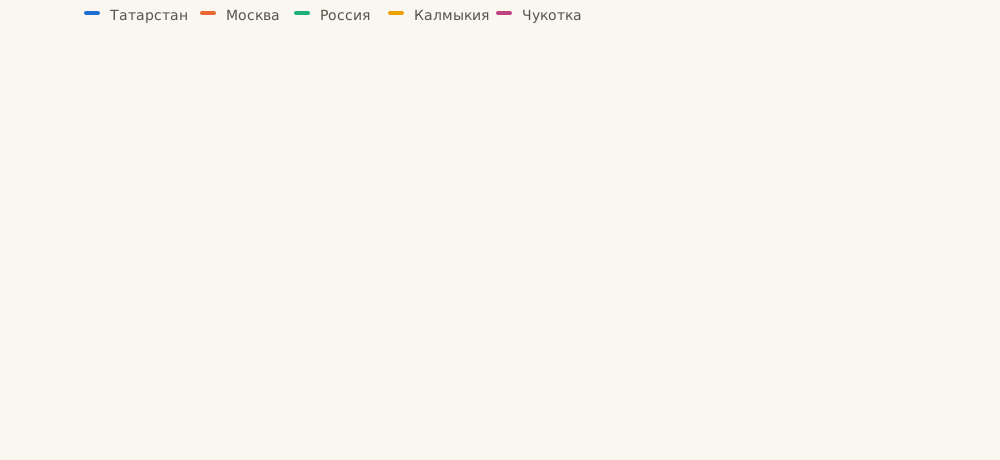
Rosstat estimates healthy life partly based on people's responses about their well-being, which is why it fluctuates more year-on-year than the standard one. See the series for all regions in the healthy life expectancy chart.
Questions and answers
Which region of Russia has the highest life expectancy?
In the Republic of Dagestan, 79.87 years according to data for 2023. Moscow is in second place with 79.38 years, Ingushetia is in third with 79.2.
Where is the lowest life expectancy?
In Chukotka (66.56 years) and in Tuva (66.59). Next are Zabaykalsky Krai (67.17), Amur Oblast (68.25), and the Jewish Autonomous Oblast (68.3).
What is the life expectancy in Moscow and Saint Petersburg?
In Moscow it is 79.38 years, in Saint Petersburg 76.55. Moscow Oblast is noticeably lower than the capital, 74.49 years, Leningrad Oblast 74.88. Detailed dynamics by year are on the page for life expectancy in Moscow.
Why do people live longer in the Caucasus?
The table does not provide a direct answer. The calculation does not depend on how many young people are in a region, so it is a matter of mortality by age. Usually, the difference is associated with lifestyle and lower alcohol consumption; there is a separate analysis regarding alcohol on alcoholism in Russia by year. At the same time, healthy life expectancy in the Caucasian republics is not always high: in Kabardino-Balkaria it is 56.3 years with an overall life expectancy of 77.14.
Is there data for 2024 and 2025?
Not by region yet: the latest figures published by Rosstat refer to 2023. When the new release comes out, the charts on the site will update automatically.
In brief
- On average across Russia, life expectancy is 73.41 years (2023).
- Leaders: Dagestan (79.87), Moscow (79.38), Ingushetia (79.2).
- Laggards: Chukotka (66.56), Tuva (66.59), Zabaykalsky Krai (67.17).
- The gap between the first and last place narrowed from 17.2 years in 2010 to 13.3 years.
- Only 30 out of 83 regions have surpassed the pre-COVID level of 2019.
- Healthy life expectancy in Russia is 61.4 years; people in Tatarstan live the longest without illness (68.3).
See also
- Rating of regions by life expectancy
- Life expectancy in Russia by year
- Life expectancy of men and women
- Rating of regions by infant mortality
Data source: Rosstat, collection "Sustainable Development Goals in the Russian Federation", 2025 edition.