Population of Saint Petersburg in 2026: how many people live in the city according to Rosstat
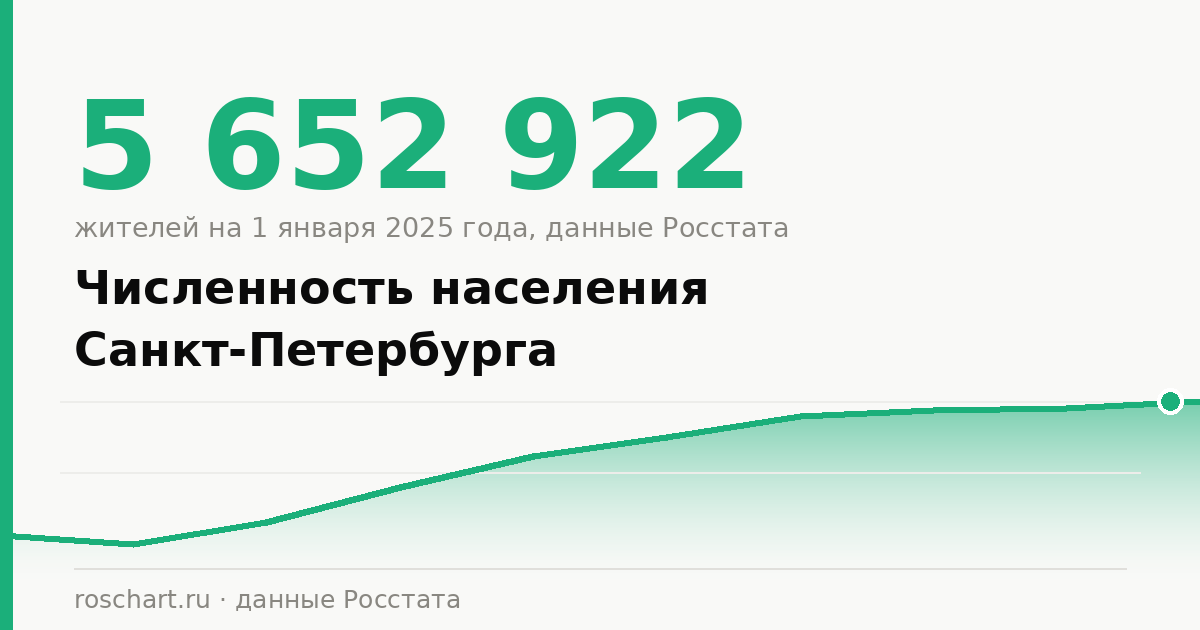
As of 1 January 2025, Saint Petersburg had 5,652,922 people. This is the latest official Rosstat estimate; figures for 1 January 2026 are not yet available on the website. In 2024 the city added 55,159 residents, although it had been slowly shrinking for the two preceding years. Saint Petersburg remains the second city in the country after Moscow, and together with Leningrad Oblast the agglomeration is home to 7,712,401 people, 5.3% of Russia’s population.
Below are the numbers by year and by censuses, showing the source of the 2024 increase, how Saint Petersburg differs from the oblast, the age structure of residents, mortality and ethnic composition. Each chart can be opened on the website in interactive form.
How many people live in St. Petersburg by year
Population on 1 January, thousand people. Since 2012 the series has been recalculated by Rosstat based on the results of the 2020 census.
| Year | Thousand people |
|---|---|
| 2000 | 4,741.9 |
| 2005 | 4,686.5 |
| 2010 | 4,832.8 |
| 2012 | 4,974.8 |
| 2014 | 5,195.7 |
| 2016 | 5,331.2 |
| 2018 | 5,494.8 |
| 2020 | 5,580.8 |
| 2021 | 5,588.5 |
| 2022 | 5,607.9 |
| 2023 | 5,600.0 |
| 2024 | 5,597.8 |
| 2025 | 5,652.9 |
At the beginning of the 2000s the city shrank: from 2000 to 2005 minus 55 thousand people. Then growth began, and it was fastest in the 2010s. In 2013 alone St. Petersburg added 124 thousand residents. Over ten years from the start of 2010 to the start of 2020 the increase was 748 thousand people.
By 2020 the growth slowed, and after 1 January 2022 the population fell slightly for two consecutive years: from 5,607.9 to 5,597.8 thousand. In 2024 the city grew again and for the first time passed the mark of 5.65 million.

In a quarter of a century since 2000 St. Petersburg grew by 911 thousand people, or 19.2%. Moscow added a third in the same period.
Open the population of all regions since 2000 →
What the censuses showed
The 2002 census counted 4,661 thousand residents in St. Petersburg, the 2010 census 4,880 thousand. The latest, 2020, was conducted in autumn 2021 and found 5,601,911 people. Between the first and the latest census the city grew by 941 thousand.
Population of Russian cities by censuses and on 1 January 2024 →
Saint Petersburg among million‑plus cities and regions
As of 1 January 2024, Russia had 16 cities with a population of at least one million. Saint Petersburg is second on this list: 5,597,763 people. Moscow is larger by 2.3 times, and the third‑largest city, Novosibirsk, is smaller than Saint Petersburg by 3.4 times. The gap between the second and third places is almost four million people.
Open the table of million‑plus cities →
As a region, Saint Petersburg ranks fourth. Ahead are Moscow, Moscow Oblast and Krasnodar Krai, where on 1 January 2025 there lived 5,842,238 people, 189 thousand more than in the city. Saint Petersburg is home to 3.9% of the country's population and 40.7% of the Northwestern Federal District's population.
The full list of large cities is examined in the article "Largest cities of Russia by population", and a comparison with the capital is in the article "Population of Moscow".
Why Saint Petersburg's population grew in 2024
The population changes for two reasons. First: how many people were born and how many died. Second: how many arrived and how many left. Deaths in Saint Petersburg each year exceed births, so migration decides everything.
| Year | Births minus deaths | Arrivals minus departures | Total for the year |
|---|---|---|---|
| 2020 | −17,948 | +4,226 | −13,722 |
| 2023 | −12,066 | +9,785 | −2,281 |
| 2024 | −15,305 | +70,464 | +55,159 |
In 2023 newcomers covered 81% of the natural decline, and the city lost 2,281 people that year. In 2024 the migration increase was 7.2 times larger than a year earlier, offsetting the loss by almost fivefold.

The figures for 2020 are taken from a collection published before the census recalculation and do not match the table above directly.
By the 2024 increase, Saint Petersburg ranks third in the country after Moscow and Moscow Oblast. In percentage terms the city grew slightly faster than the capital: plus 0.99% versus 0.95%.

Population size and its components of change by region for 2024 →
How many are born and die in Saint Petersburg
In 2023 the city saw 48,016 births and 60,082 deaths. Per thousand residents this is 8.6 births and 10.7 deaths. The birth rate is exactly average for Russia, while mortality is lower: the country average is 12.1.
Births, deaths and natural increase by region for 2023 →
Saint Petersburg and Leningrad Oblast
As of 1 January 2025, 2,059,479 people lived in Leningrad Oblast. Since 2000, the oblast has grown by 22.1%, faster than the city itself. In 2024 it added 23,717 residents, and they were all migrants: natural decline of 10,407, migratory increase of 34,124.
The oblast has been growing thanks to relocations for a long time. In 2020, when Saint Petersburg was estimated to be losing population, the oblast added 16,839 people. In 2023, migrants more than doubled its natural decline, while the city covered only 81% of its own. Together the city and the oblast counted 7,712,401 people at the beginning of 2025.
Salaries, prices and other regional indicators are collected on the page Leningrad Oblast.
Change in population by region for 2023 →
Age structure of Saint Petersburgers: a city of students and retirees
As of 1 January 2022, Saint Petersburg had 838,937 people younger than working age, 15.0% of the population. In Russia the share of children and adolescents is 18.6%. People older than working age in the city numbered 1,403,510, or 25.0%, compared with 24.0% nationwide. For each child in Saint Petersburg there are 1.7 people of retirement age, versus 1.3 on average in Russia.
The age pyramid of Saint Petersburg shows a noticeable step at 18 years. There were 46,356 seventeen‑year‑olds in the city, while eighteen‑year‑olds numbered 66,153, 43% more. Across the country the difference between these ages is 3.6%. Most likely these are first‑year students from other regions who came to study at Saint Petersburg universities.
Population by sex and age by region as of 1 January 2022 →
The share of older people in the city is decreasing: 26.8% at the start of 2019, 24.8% at the start of 2024. The reason is the pension reform: the working‑age threshold is moving upward, and some residents shift from one group to another only in the statistics.
Population and share of older ages by region since 2012 →
What people die from in St. Petersburg
In 2023, the city recorded 1,073.1 deaths per 100,000 inhabitants, 11% less than the Russian average (1,206.2).
St. Petersburg differs most in external causes. From injuries, poisonings, homicides and suicides, 61.8 people per 100,000 die here, compared with 107.1 nationwide. Traffic accidents claim 3.5 people per 100,000, versus 9.2 in Russia. Deaths from tuberculosis are half as frequent, and from diseases of the digestive organs a third as frequent.
Only two items are above average. Diseases of the circulatory system are almost at the national level: 564.9 versus 556.7. Mortality from neoplasms is 15% higher than the average: 227.0 per 100,000 versus 197.4.

How long people live on average in the city is shown on the page life expectancy in St. Petersburg.
Mortality by main causes in each region →
Men, women and ethnic composition according to the 2020 census
Of the 5,601,911 residents of St. Petersburg recorded in the census, 2,525,726 were men and 3,076,185 were women. There are 1,218 women per thousand men. In Moscow this imbalance is smaller: 1,153.
Ethnicity was indicated by 4,717,233 people. For 884,678, or 15.8% of residents, the field was left blank, of which 562,519 people explicitly refused to answer. The shares below are calculated from those who indicated ethnicity.
| Ethnicity | People | Share |
|---|---|---|
| Russians | 4,275,058 | 90.6% |
| Ukrainians | 29,353 | 0.62% |
| Tatars | 20,286 | 0.43% |
| Azerbaijanis | 16,406 | 0.35% |
| Belarusians | 15,545 | 0.33% |
| Armenians | 14,737 | 0.31% |
| Uzbeks | 12,181 | 0.26% |
| Tajiks | 9,573 | 0.20% |
| Jews | 9,205 | 0.20% |
Among Russians, Ukrainians, Tatars and Belarusians there are more women than men. Among Uzbeks and Tajiks it is the opposite: among Uzbeks there are 7,361 men and 4,820 women, among Tajiks 6,124 men and 3,449 women.
National composition of St. Petersburg according to the 2020 census →
How the national composition of the country as a whole is arranged is explained in the article "Peoples of Russia: national composition".
How Rosstat counts the population of St. Petersburg
Between censuses Rosstat keeps its own count: it takes the result of the latest census, each year adds those born and arrived, subtracts those who died and left. After a new census the whole series is recalculated.
For St. Petersburg the recalculation after the 2020 census turned out to be large. In the collection published before it, the figure for 1 January 2020 was recorded as 5,398,064 people. In the recalculated series for the same date it is 5,580.8 thousand, 183 thousand more.
From this a simple rule follows. For year‑by‑year dynamics use a single recalculated series, as in the table at the beginning of the article, and do not mix numbers from different collections.
Population change by region for 2020, before recalculation according to the census →
Questions and Answers
How many people live in Saint Petersburg in 2026?
The latest official estimate from Rosstat is for 1 January 2025: 5,652,922 people. Estimates for 1 January 2026 are not yet available on the website.
How many people live in Saint Petersburg and Leningrad Oblast together?
On 1 January 2025 there were 7,712,401 people: 5,652,922 in the city and 2,059,479 in the oblast.
Is the population of Saint Petersburg growing or shrinking?
In 2024 it increased by 55,159 people. Before that, for two consecutive years the number slightly decreased: by 7.9 thousand in 2022 and by 2,281 people in 2023.
How many times larger is Moscow than Saint Petersburg?
On 1 January 2025 it was 2.3 times: 13,274,285 versus 5,652,922 people.
In Brief
- On 1 January 2025, Saint Petersburg had 5,652,922 residents, the second‑largest city in Russia and the fourth region by population.
- Since 2000 the city has grown by 911 thousand inhabitants, or 19.2%.
- Deaths in the city exceed births. The 2024 increase of 55,159 people was entirely due to moves: migration growth rose by 7.2 times.
- Together with Leningrad Oblast, the agglomeration totals 7,712,401 people, and the oblast is growing faster than the city.
- Children in Saint Petersburg are fewer than the national average (15.0% versus 18.6%), while eighteen‑year‑olds are 43% more numerous than seventeen‑year‑olds.
- Mortality is 11% lower than the Russian average, and deaths from external causes are almost half as high.
See Also
- Saint Petersburg: all regional indicators
- Average salary in Saint Petersburg
- Subsistence minimum in Saint Petersburg in 2026
- Population of Russia by regions
- Population of Russia in 2024
}